
Rude Awakening: Over Half of Americans Are Annoyed By Neighbors Multiple Times a Year
Is a neighbor driving you crazy? You're not alone.


Is a neighbor driving you crazy? You're not alone.
You just rolled out of bed, brewed a pot of coffee, and arrived at your “office”-the laptop on your kitchen table, where you’ve been working from home during these past two pandemic years.
The morning is full of Zoom meetings and to-do lists. It’s all going smoothly, until you realize that your walls are…vibrating a bit.
Where is that noise coming from?
It turns out your neighbor thinks that 10 am is the best time to watch Avengers: Endgame on full blast.
Dealing with unpredictable neighbors is an expected part of homeownership, just like getting homeowners insurance or paying your mortgage. However, anyone who’s ever had noisy neighbors can attest how quickly it can shred your nerves.
We polled 1,000 Americans across the country (between the ages of 18 and 95, and living in cities, towns, rural areas, and suburbs) to see how often they are annoyed by their neighbors, and the emotions that arise in these situations.
 TL;DR
TL;DR
Find yourself frequently annoyed with noisy, inconsiderate neighbors? Our survey reveals that you are definitely not alone.
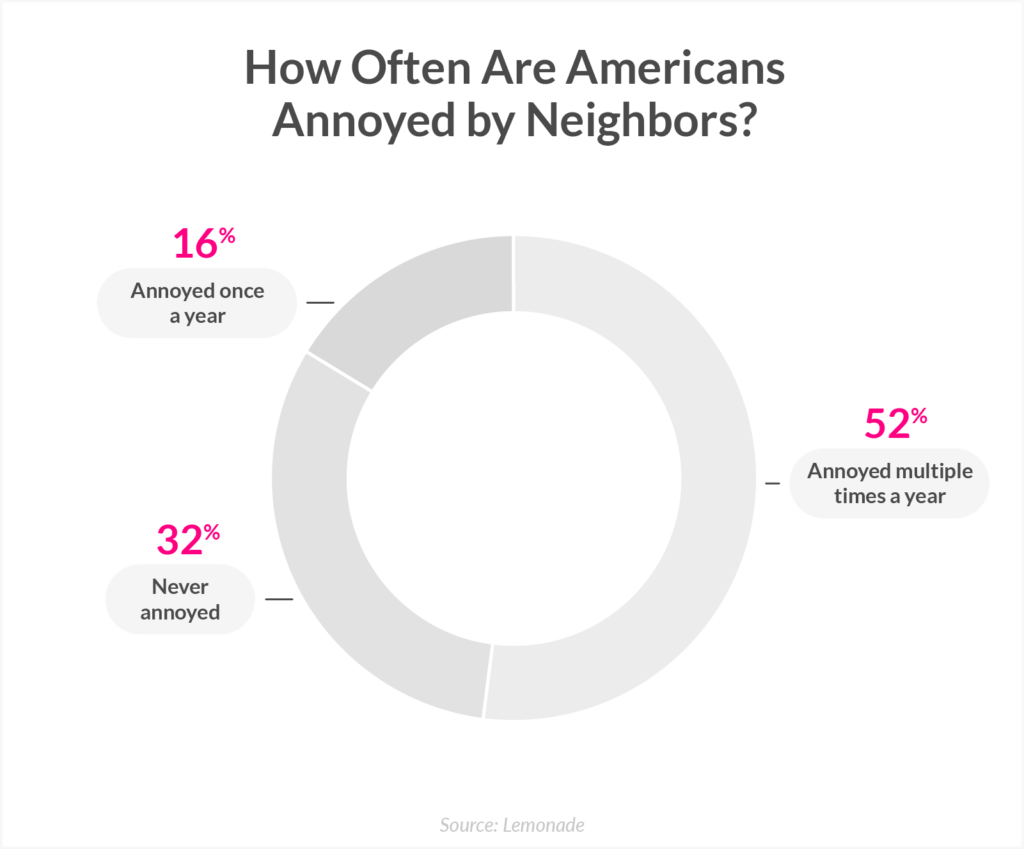
It’s more common than you might think for people to be annoyed by their neighbors. In fact, 52% of folks are annoyed multiple times a year by their neighbors-with a whopping 35% of people being annoyed by their neighbors on a monthly basis.
Meanwhile, 16% of survey participants claimed they are annoyed once a year by fellow community members. Those folks are either lucky, or extremely patient. (Maybe they just have thicker walls.)
Men and women are almost equally bothered by their noisy neighbors.
There is only a 2% difference between men and women, with men feeling marginally more annoyed or irritated by their neighbors, although that result is within the survey’s margin of error.
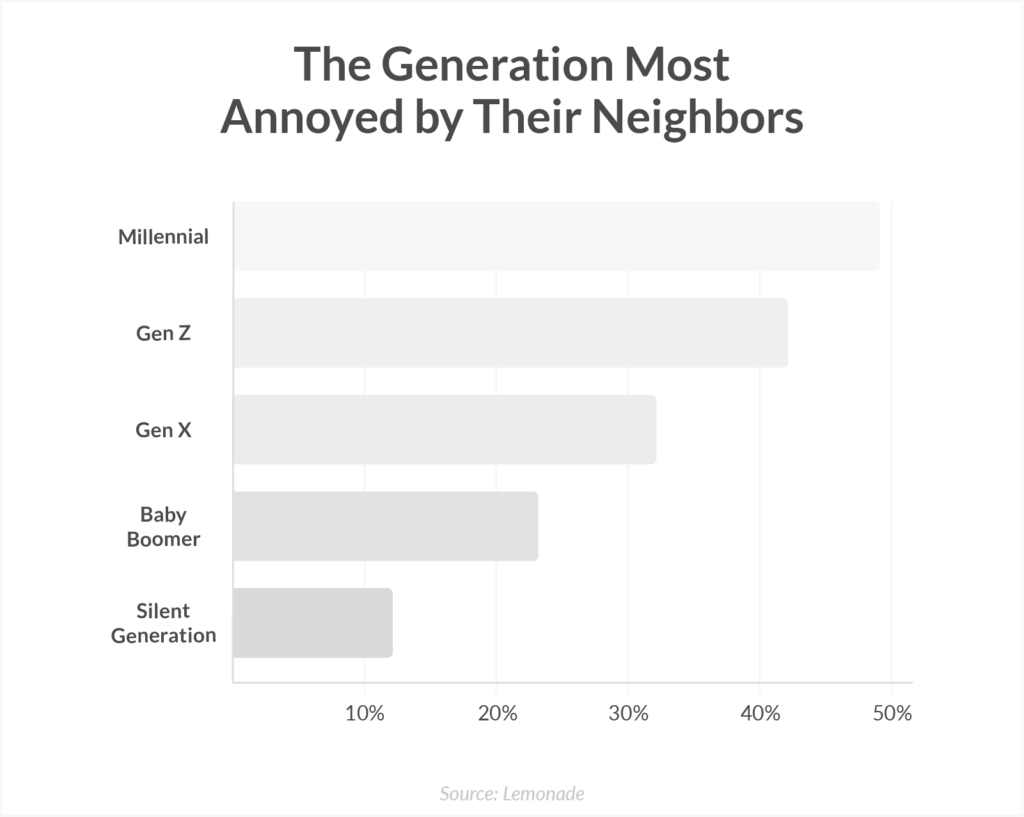
Millennials are actually the most disrupted generation when it comes to loud neighbors. In fact, 49% of millennials report getting annoyed at least once per month.
Gen Z comes in a close second place based on our noisy neighbors survey. 42% of Gen Z individuals are annoyed multiple times per a month.
Why might this be? Well, the age range of these populations might mean that a percentage of those polled are living in apartments, or student-style housing-notoriously noisy environments.
Meanwhile, members of the silent generation, and baby boomers, prefer to live in flexible spaces that are low maintenance. Many own single-family homes or live in condo communities, where noise levels are typically on the lower end, partially due to stricter HOA rules.
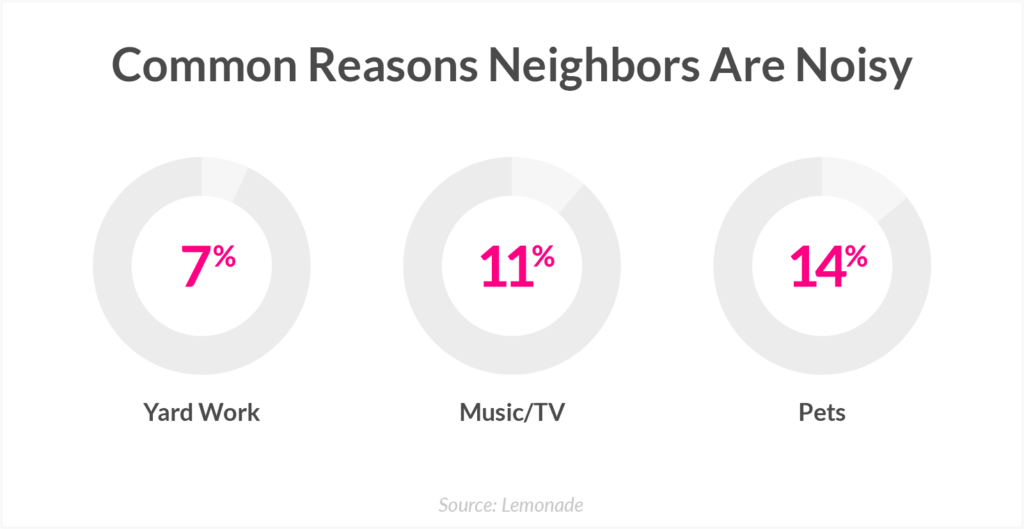
You might think quarantine-weary youngsters hosting massive parties would be a leading cause of annoying noise levels. However, according to our noisy neighbors survey, only 9% of respondents named “parties” as a common annoyance.
So if wild ragers aren’t an issue, then what are some frequent neighborly complaints?
Millennials cited loud music or TV as the most common reason neighbors are noisy. It makes sense, especially if home is a dense apartment complex with thin walls-you might get an accidental front-row seat when your neighbor decides to binge Ozark.
According to Gen Z, kids screaming or crying is one of the most common reasons their neighbors are noisy. With the rise in housing prices, more and more families are occupying rental communities that are typically full of younger people. This might mean that Zoomers are being confronted by a reality new to them: babies and toddlers are adorable, but they can be quite… loud.
Meanwhile, baby boomers cite pets barking, or children crying, are the most common reasons their neighbors are noisy.
Based on a survey conducted by The Waycroft, 45% of neighbors are the loudest in the evening, and only 10.4% of neighbors are the loudest in the morning. 24.6% of neighbors are the loudest in the middle of the night, and 20% of neighbors are the loudest in the afternoon.
Perhaps surprisingly, some baby boomers and the silent generation feel compassion or amusement when their neighbors cause a ruckus.
However, our survey results found that noisy neighbors most commonly made respondents feel “annoyed” or “irritated,” with 43% saying they have these emotions when hearing disturbances from other folks. One in 10 Americans feels stressed or anxious when their neighbors are noisy.
Meanwhile, 6% of Americans feel frustrated by their neighbors, and nearly 80% of Gen Z feel frustrated by other tenants.
It can be a real drag to have to put up with a neighbor’s incessant noise-their late-night movie-watching, early morning lawn-mowing, or boisterous weekend barbeques.
But would you actually move to get away from an annoying neighbor?
Turns out, a lot of people would. The following data is based on a survey conducted by HomeAdvisor.
Turns out everything is bigger in Texas-including the problem of noisy neighbors.
According to the previously mentioned study conducted by HomeAdvisor, Texas has four of the loudest cities in the country: Fort Worth, El Paso, Austin, and San Antonio. Yeehaw!
California is a close second state when it comes to the loudest neighbors.
Living next to a noisy neighbor doesn’t mean you have to start cruising Zillow for a new home. There are ways to navigate a potential issue with a minimum of awkwardness.
If your neighbors are constantly irking you, try to document the offenses. Simply keep a notebook whee you jot down what you hear, how long the noise occurs, and the date.
For example: “April 7, 2022, dog barking from 11:00 a.m. until 9:00 p.m.”
After you gather a significant amount of disturbances-and if your neighbor isn’t responsive to your concerns-you can bring the evidence to your landlord, property manager, or HOA.
Since most shared living spaces tend to have thin walls, a courtesy knock could help.
All you have to do is knock on your shared wall to provide a personal and polite way to keep the noise down. Hopefully your neighbor has enough self-awareness to know that if someone is knocking on the wall, it’s probably best to turn the sound down.
If your neighbor addresses your knock, be calm and collected to avoid coming across as belligerent. You’ll also avoid a tragic/comedic scenario where you and your neighbor are simply banging on each other’s walls with broom handles and other objects.
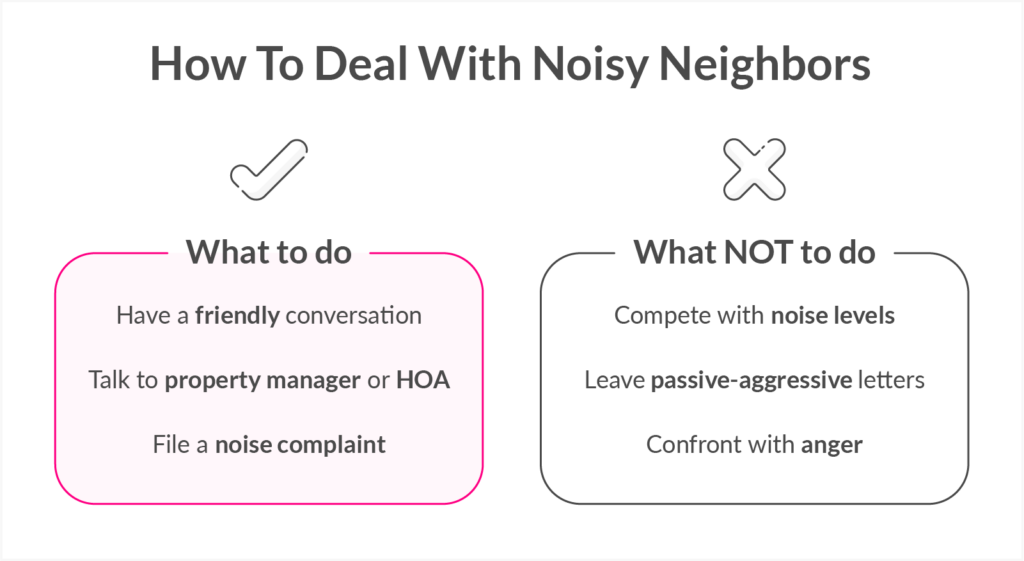
A face-to-face chat can go a long way. Perhaps your neighbor isn’t even aware of the noise they are causing.
All you have to do is politely and casually bring up the sounds the next time you bump into them. (If you are afraid of any confrontation, you can always loop in the property manager or homeowners association.) Maybe it’s easier to just knock on their door and discuss the issue. If so, consider wearing a mask, since we’re still in the middle of a pandemic.
It can be tempting to get your frustration out in writing-and it’s also an easier way out than addressing your concerns in person. But this tactic is bound to backfire, especially if you take a snide or sarcastic tone (“I’m not sure about you, but some of us have to work in the morning…”).
When all else fails and the noise continues, it might be time to contact your homeowners association if you have one. If you are renting, you should contact your landlord or property manager.
Each city has its own noise ordinances and laws to ensure loud sounds aren’t escalating.
Make sure you have collected enough information to prove you have a case against the loud tenants. Come prepared to show proof of these instances.
To help you file a disturbance without the hassle, our team created a noise complaint letter template. Find all of the information you need to include in your noise complaint at the link below.
Every city and county in the U.S. has noise ordinances restricting excessive sound during certain hours. Most municipalities define quiet hours as 10 p.m. to 7 a.m. on weekdays and 11 p.m. to 8 a.m. on weekends. Violations can result in a warning, a fine, or in repeated cases, a misdemeanor citation.
If your landlord or HOA fails to act, file a noise complaint directly with your local police non-emergency line or city code enforcement office. In extreme rental situations, persistent unresolved noise may constitute a breach of your right to “quiet enjoyment” — potentially grounds for lease termination without penalty.
Homeowners insurance won’t cover lost sleep or noise-related stress. But if a neighbor’s behavior causes physical damage — a party guest breaks your fence, a dog destroys your garden — your policy’s property damage coverage may apply, subject to your deductible and policy terms.

We know it’s tough living in uncomfortable situations, especially loud environments. That’s why it’s important you know how to document offenses, knock politely, and file a noise complaint.
But noisy neighbors aren’t the only peril you’ll face as a homeowners. If you’re looking to protect yourself and your property against life’s other uncertainties, check out Lemonade’s Homeowners insurance. Obtain your quote within minutes, without all of the annoying paperwork.
According to a 2022 survey of 1,000 U.S. adults, 52% of Americans are annoyed by their neighbors multiple times a year. 35% report being annoyed at least once a month. Only a small minority say they are never bothered by neighbor noise.
Millennials are the most disrupted generation, with 49% reporting annoyance at least once per month. Gen Z follows closely, with 42% reporting annoyance multiple times per month. Both generations are more likely to live in apartments or dense housing, which contributes to higher noise exposure.
Noise complaints vary by generation. Millennials most frequently cite loud music or TV. Gen Z most commonly complains about kids screaming or crying. Baby boomers cite pets barking and children crying. Across all groups, parties rank surprisingly low — only 9% of respondents named them as a common annoyance.
According to survey data from The Waycroft, 45% of neighbors are loudest in the evening. About 24.6% are loudest in the middle of the night, and 20% are loudest in the afternoon. Only 10.4% are loudest in the morning.
Yes, 53% of people have considered moving or have actually moved because of a neighbor, according to a HomeAdvisor survey. Apartment dwellers are more likely to relocate, with 61% saying they would move due to neighbor issues. Even among single-family homeowners, 41% say they would consider it.
The most effective steps include documenting noise offenses with dates and times, having a calm direct conversation with your neighbor, filing a formal complaint with your landlord or HOA, and in persistent cases, contacting local authorities who enforce noise ordinances. Passive-aggressive notes are generally ineffective and tend to escalate tensions.
A few quick words, because we <3 our lawyers: This post is general in nature, and any statement in it doesn’t alter the terms, conditions, exclusions, or limitations of the policies issued, which differ according to your state of residence. You’re encouraged to discuss your specific circumstances with your own professional advisors. The purpose of this post is merely to provide you with info and insights you can use to make such discussions more productive! Naturally, all comments by, or references to, third parties represent their own views, and Lemonade assumes no responsibility for them. Coverage may not be available in all states. Please note that statements about coverages, policy management, claims processes, Giveback, and customer support apply to policies underwritten by Lemonade Insurance Company or Metromile Insurance Company, a Lemonade company, sold by Lemonade Insurance Agency, LLC. The statements do not apply to policies underwritten by other carriers.
How did we gather the noisy neighbor facts above? Glad you asked!
The survey featured in this post was conducted on YouGov Direct. One thousand U.S. adults ages 18 and older were surveyed on March 17, 2022, between 4:05 p.m. and 9:06 p.m. EST. Data is weighted on age, gender, education level, political affiliation, and ethnicity in order to be nationally representative of adults 18 and older in the United States. The margin of error is approximately 3.1% for the overall sample.
Share


Please note: Lemonade articles and other editorial content are meant for educational purposes only, and should not be relied upon instead of professional legal, insurance or financial advice. The content of these educational articles does not alter the terms, conditions, exclusions, or limitations of policies issued by Lemonade, which differ according to your state of residence. While we regularly review previously published content to ensure it is accurate and up-to-date, there may be instances in which legal conditions or policy details have changed since publication. Any hypothetical examples used in Lemonade editorial content are purely expositional. Hypothetical examples do not alter or bind Lemonade to any application of your insurance policy to the particular facts and circumstances of any actual claim.